The New ITIL
The New ITIL

Most people reading this blog will be aware that a new version of ITIL was announced recently. The new publications and exams should be available very soon, but here is a summary of what’s coming for those of you who can’t wait.
What’s the new version of ITIL called?
The official name of the new product is “ITIL”, that’s it. If you need to distinguish this latest release from earlier versions, for example when you’re talking about what exams you’ve passed, then you could call it “ITIL version 5” or “the new ITIL”. I guess the reason for this is that ITIL is not fundamentally changing, this is just a refresh to resolve issues that people noticed in the previous version and to catch up with how the industry has changed since ITIL 4 was published in 2020.
What was wrong with ITIL 4?
ITIL has been constantly evolving since the first books were published more than 30 years ago. Every time a new release of ITIL has been published there have been people who complain that there was nothing wrong with the previous version, and they are often correct, but if you were still using guidance from the early 1990s today then you’d be missing out on many innovations and improvements.
There were a few parts of ITIL 4 that were more confusing than helpful, for example:
- the service value chain described activities such as “Design and transition” or “Obtain/build” which were intended to help organizations design and improve their own value streams, but these were not well enough described to make this easy
- there were practices that described some aspects of how to create digital products, but the entire focus of ITIL was on managing services, and management of digital products was barely mentioned
- there was some content on experience management, especially in the “Drive Stakeholder Value” publication, but this was not sufficient for a modern people-focussed organization
- the guidance was intended to be used by service providers of all sorts, whether internal IT departments or managed service providers working with external clients, but there was little discussion of what approaches might be needed in different circumstances
- there was almost no content on how AI can be used to support IT service management
What are the differences from previous versions?
The biggest change from previous releases is the scope of ITIL. Management of IT services is important, but isn’t sufficient for a modern digital organization, so ITIL now describes best practice for managing digital products and services. This different focus impacts many details of how specific areas of ITIL are described – especially the digital product and service lifecycle. Hopefully this change in focus will help organizations to manage their digital products and services more holistically, with less division and conflict between product and service teams.
The ITIL service value system is barely changed, the only noticeable difference is the replacement of the “service value chain” with a new “digital product and service lifecycle”. Other aspects of the service value system, including governance, guiding principles, management practices, and continual improvement only have minor changes.
There is additional content on the use of AI to support many of the activities that ITIL recommends.
The digital product and service lifecycle describes eight activities. All of these activities are required to create and manage digital products and services, but each organization may only perform some of these, collaborating with other organizations to ensure that all aspects are managed. The eight lifecycle activities are:
- Discover
- Design
- Acquire
- Build
- Transition
- Operate
- Deliver
- Support
Many of these terms will be recognisable to people with previous ITIL experience, and hopefully you will be able to see how some or all of these exist within your own organization. These activities are also used to explain how different types of organization contribute to value streams in complementary ways.
The new ITIL Foundation publication describes these eight activities in some detail, including workflows, key outputs, and metrics. Details of individual practices are left to the practice guides, although Foundation does include a structured one-page description of each of the 34 ITIL management practices.
The purpose of a service is still to co-create value, but there is additional content describing how value is not just financial, but requires focus on experience and sustainability in addition to more technical aspects of service quality. In fact there is an entire publication about how to measure and manage experience of the many stakeholders in a digital product or service.
What publications and exams will there be?
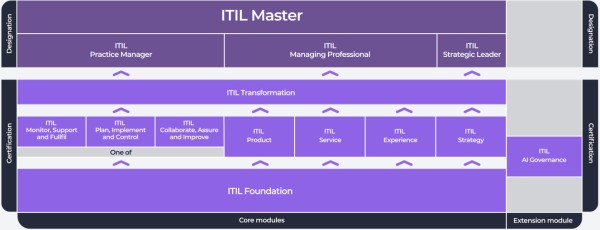
Foundation
The new ITIL still has a Foundation publication and exam, and this will almost certainly still be the most popular part of ITIL for people to study and use.
Practices
The 34 ITIL management practices are regularly refreshed, and this will continue as needed. There are already combined exams covering multiple practices and these will continue largely unchanged.
Transformation
There will be a new ITIL Transformation publication describing how organizations can transform their service management system. This will provide practical guidance which can be used to help adopt ideas from all areas of ITIL, or even from other management system guidance. This publication will be an updated version of the “How to Implement” publication which was made available online to PeopleCert Plus members a few months ago.
ITIL Product and ITIL Service
These two publications will describe how the digital product and service lifecycle can be used by different types of organization to help them manage and improve creation and delivery of digital products and services.
ITIL Experience
This publication will describe how to measure, manage, and improve experience of all stakeholders.
ITIL Strategy
This publication will provide guidance on how to develop and then implement a strategy for digital product and service management
AI Governance
This publication will be based on an updated version of the AI Governance white paper which is currently available from ITIL.com.
Summary
ITIL has continually evolved and the latest release builds on previous versions, rather than replacing them. There is more focus on digital products, and on using AI to support digital products and services, supported by a new digital product and service lifecycle. There are also new publications to help organizations manage stakeholders’ experience, and to help guide transformation of the organization’s service value system. Other than this, the new version is basically just an update to what you already know and love.
Image credits
Staircase photo: Kunal Singh
ITIL qualification scheme: PeopleCert
This work is licensed under CC BY-SA 4.0


-

The New ITIL
A new version of ITIL has been announced, here is my summary of what has changed, and more importantly what has not changed.
-

Defining your risk appetite
How to create simple definitions of risk appetite levels, and then assign these to each of your organization’s projects, services, business units or any other clearly identifiable part of your work.
-

Mentoring 101
Mentoring is a great way to develop both professionally and personally, and the mentor can gain as much from the relationship as the mentee. This blog gives an overview of how you can get started as a mentor, or as a mentee.
-

A great customer journey has to be planned from end-to-end
Have you tried mapping out your customers’ journeys? If not, then it’s an exercise well worth doing.
-

Do you know who you're talking to
It’s easy to assume you know who you’re talking to, but it’s just as easy to make a mistake. Every time you answer the phone, or phone someone else, make sure you really do know who you’re talking to.